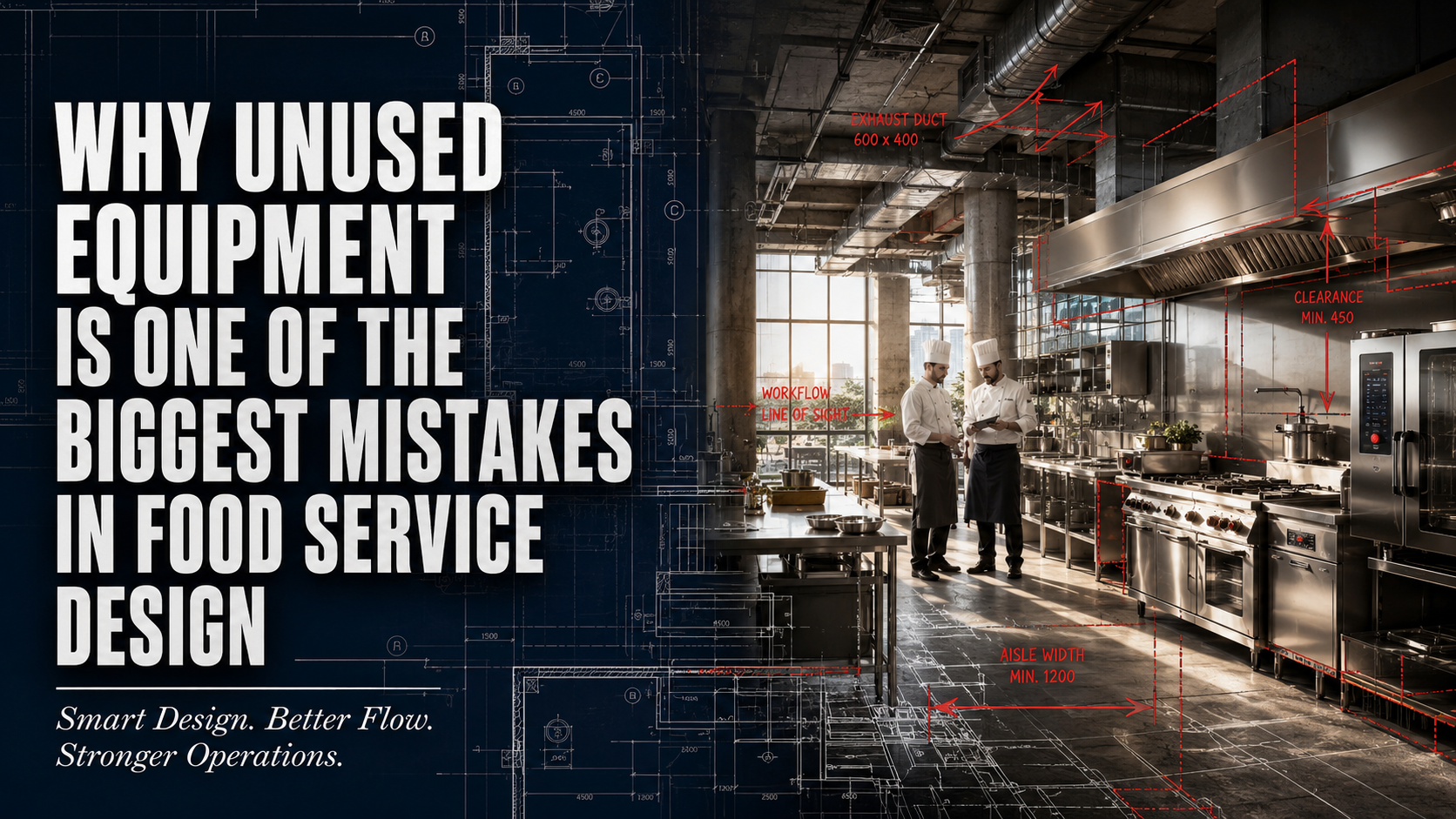
Most of the commercial kitchens have at least one or two pieces of equipment that just sit still in the kitchen collecting dust rather than being used for the purpose they were bought. Nobody talks about it much. It’s just there, taking up space, the way a treadmill ends up as a clothes rack in a lot of homes.
For a kitchen, though, unused equipment means that some calculations or decisions have gone wrong in the design process.
In good Commercial Kitchen Design in India projects, this shouldn’t happen at all, and when it does, it usually points back to a gap earlier in the design process rather than a one-off bad purchase.
It’s Not Really About the Equipment
The instinct is to see an unused multipurpose oven or an idle blast chiller and think of it as a bad purchase. Maybe someone got convinced by a vendor to buy fancy equipment, or maybe they just bought a wrong model of that equipment. Sometimes that’s part of it. The mistake happened somewhere further back, in the commercial kitchen layout phase, when nobody connected that piece of equipment to how the kitchen would actually run.
Honestly, a good food service designer works this way: the menu, the covers, the staff, and finally the workflow of the kitchen. The things mostly went wrong when someone chose the equipment simply because the vendor tells them it’s in trend or every efficient kitchen has them, so they bought the equipment without giving any thought if that specific kitchen operation really needs them or not. So naturally they end up with a kitchen having tools that don’t really match the process meant to use them.
Why It Costs More Than It Looks Like
On the surface, an idle piece of equipment seems like a contained problem. It costs money; it’s not earning its keep, that’s unfortunate but not catastrophic. In practice, the damage runs deeper than that.
There’s the capital itself, often a meaningful chunk of the equipment budget tied up in something producing zero return. There’s the space that could have gone to something the kitchen actually needs, maybe one more prep counter, a second wash station, or maybe a room to move during a rush. There’s also the workflow disruption, because a piece of equipment in the wrong spot doesn’t just sit there quietly; it becomes an obstacle staff has to walk around or work through every single shift.
Add all of that up over a year, or over the life of the building, and an unused piece of equipment stops looking like a minor design miss. It starts looking like a design failure with a compounding cost, one that thorough Commercial Kitchen Planning is meant to catch long before opening day.
Where the Mistake Actually Gets Made in Commercial Kitchen Layout Decisions
Unused equipment rarely comes from a single bad decision. It usually comes from a design process that skipped a step, specifically, the step where equipment choices get tested against the operation instead of against a spec sheet.
Most common patterns are these: equipment gets chosen to match an aspirational menu instead of the one the kitchen will realistically run day to day. A piece of equipment gets specified because a similar property has one, without asking whether this kitchen’s volume or staffing actually calls for it. Or the equipment schedule gets finalized before anyone has mapped out how food, staff, and service actually move through the space, so even good equipment ends up in a spot that makes it inconvenient to use.
A common example is the standalone pasta cooker in a restaurant that only serves pasta as a small side to a much larger menu. Don’t get me wrong, it’s a genuinely good piece of equipment on its own; it’s super fast and helpful in the pasta-making process. But if pasta only accounts for a handful of covers a night, that cooker ends up running for a few minutes during service and sitting idle the rest of the time, occupying a line position that could have gone to a second range or an extra prep surface the kitchen actually needs every shift. The equipment wasn’t wrong. It was chosen for a menu the kitchen doesn’t actually run at the volume that would justify it.
In almost every case, the common thread is the same. Equipment decisions got made before the operational picture was clear, not after.
How to Prevent This Big Mistake From Happening
The fix isn’t complicated, though it does require sequencing the design process differently than most projects default to. Equipment decisions need to follow operational analysis, not lead it.
That starts with a genuinely honest menu, not the aspirational version everyone hopes to serve eventually, but the one the kitchen will actually run in its first year or two. Sound Commercial Kitchen Planning continues with a realistic read on staffing, since a piece of equipment that demands a skilled specialist to operate properly is a poor fit for a kitchen that’s often short-staffed or relies on a rotating crew. It means testing equipment choices against peak volume, not an average shift, because a kitchen that looks perfectly equipped on a quiet Tuesday can fall apart during a Saturday banquet. And it means walking through the actual workflow, from receiving and storage to preparation for cooking to service to wash, and checking whether the commercial kitchen layout puts each piece of equipment somewhere staff will genuinely want to use it, not just somewhere it happened to fit on the floor plan.
None of this is exotic. It’s the basic discipline of designing a kitchen around how it will be used, rather than around what looks good in a rendering or a proposal.
Where OPSTRAH Fits Into This
This is really the core of what operational programming is meant to catch before it becomes a permanent fixture in someone’s kitchen. At OPSTRAH, equipment decisions get built from the operation itself, the real menu, the real volume, the real staff who’ll be working the line, rather than from a catalogue or an aspirational concept. That’s the work that happens before anything gets specified, so a client doesn’t discover eighteen months into operation that a major piece of equipment never really earned its place.
The Real Design Failure
Unused equipment isn’t really about the equipment. It’s a visible symptom of a design process that moved too fast toward selection and not carefully enough through the operational thinking that should have come first.
For anyone planning a new kitchen or renovating an existing one, the lesson is simple. Every piece of equipment on the schedule should be able to answer one direct question: who is using this, how often, and why. If that answer isn’t clear before the equipment gets ordered, it’s worth pausing and asking it, because the alternative is an expensive shelf standing in a kitchen that could have used the space, the budget, and the attention somewhere else.
Whether the project is a single restaurant or a multi-outlet hotel, treating this as a core part of Commercial Kitchen Design projects, rather than an afterthought, is what keeps equipment from ending up unused in the first place.