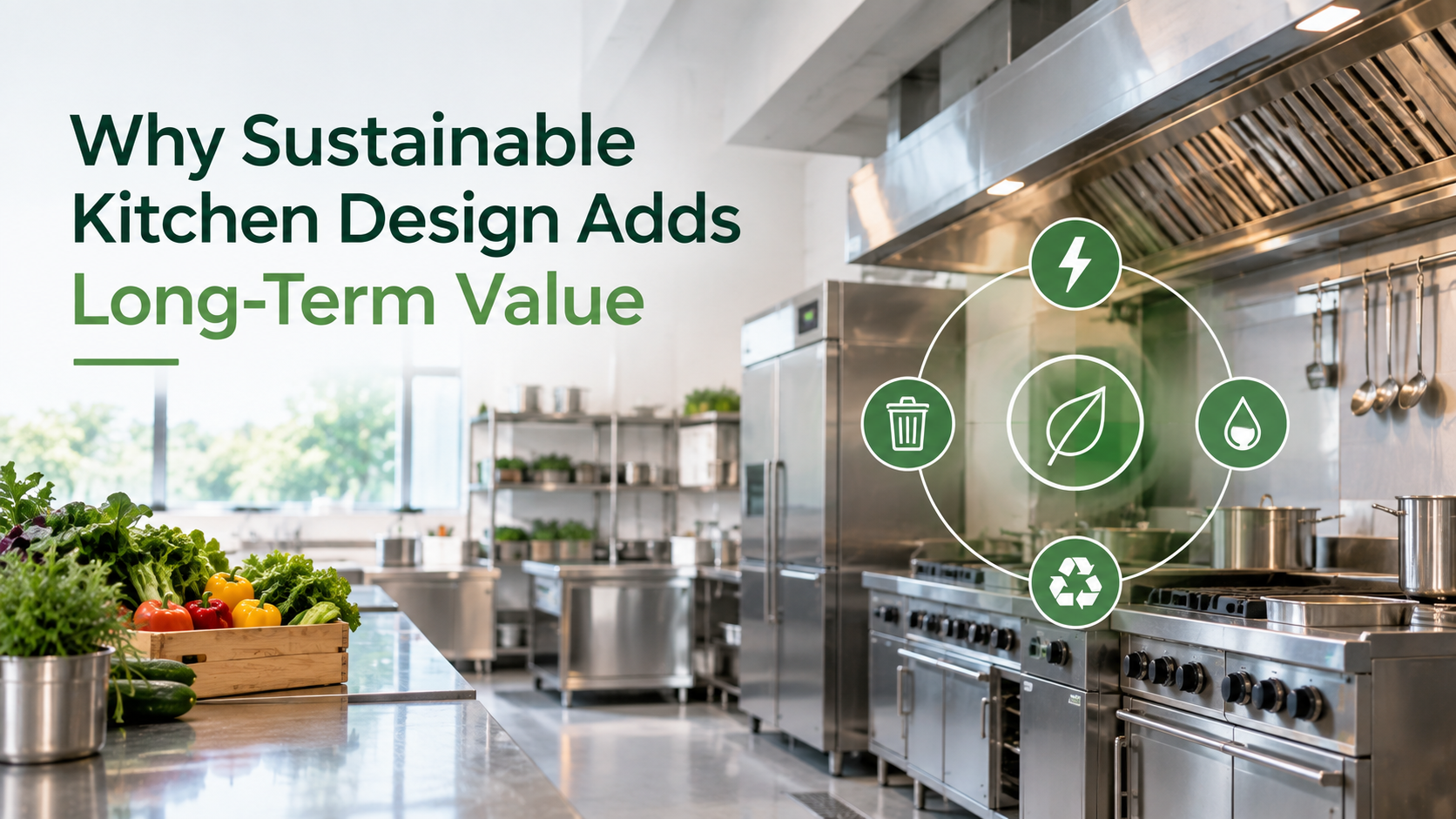
Ask any project team what happens to kitchen sustainability when the budget gets tight. It goes off the list first. Every single time. Value engineering strips it out, or it lives on as one line in the brochure and nothing more. Which is a real shame, because good Sustainable Kitchen Designing is where a building’s energy, water, waste and refrigerant use all meet in one small, hard-working space.
Here’s what we keep coming back to. The long-term value shows up in four places: operating cost, regulatory risk, reporting data and asset flexibility. Once the ducts are sized, the refrigeration is chosen and the drains are laid, you’re mostly living with whatever’s on the drawing.
So let’s walk through each lever, tackle the “it costs more” objection head-on, and finish with two short question lists, one for developers and one for ESG teams. Take them into your next design review.
Why the Kitchen Is a Building’s Sustainability Hotspot
Walk through a busy mall or hotel and the kitchen is rarely the loudest thing in the building. It is the busiest, though. Cooking loads, exhaust fans, cold rooms, dishwashing, food scraps. All of it packed into one zone, running long hours, day after day.
That concentration is the opportunity. A handful of design decisions in one area can move a big share of the building’s utility use, waste stream and refrigerant inventory. We’re keeping this section qualitative on purpose. Intensity figures from other markets don’t travel well to Indian conditions, and we’d rather not hand you a number we can’t stand behind.
One question runs through everything below: who actually captures the value? Developers build the kitchen. Operators and tenants often pay the bills. Ignore that gap and even a strong sustainability case falls flat in the boardroom. So for every lever, we’ll say who benefits.
Lever 1: Lower Operating Cost Through Smarter Equipment Planning
Start with ventilation, because it’s the biggest lever in most commercial kitchens. Fans tend to run flat out whether the cooking line is roaring or sitting idle, and every bit of that extracted air has to be replaced with conditioned make-up air. Expensive habit, and an easy one to fall into.
The evidence is decent. A US ENERGY STAR profile of a hotel kitchen retrofit recorded a 57% cut in average fan power after demand-controlled ventilation went in. A California Energy Commission study found overall energy savings of 20-40% per site, and at two of them, demand control alone added more than 50% in ventilation savings. Those are US sites, so treat them as proof the mechanism works, not as a forecast for your project.
Ventilation isn’t the whole story, of course. Heat recovery grabs energy that would otherwise leave through the exhaust or the drain. Efficient equipment trims the load right at the source, which is why equipment planning belongs at the front of the design process and not at the tail end. Water-recycling loops cut what you buy and what you discharge. None of it is glamorous. All of it shows up on the monthly bill.
Now the split-incentive bit. Where the developer owns and runs the kitchen (hotels, hospitals), the savings land straight on the developer’s books. Where space is leased, the route is less direct. The value reaches you through leasing appeal, lower service charges and better tenant retention. Tenants who spend less to run their kitchens tend to stay longer. Real money, just slower to arrive.
Lever 2: Regulatory Risk, Food Waste Management and Refrigerants
Regulation is the lever people underestimate, mostly because it arrives on a schedule and the schedule is easy to ignore. Until it isn’t.
Take waste first. India’s 2026 solid waste rules took effect on April 1, 2026, and bulk generators are expected to process wet waste on-site or obtain certification. A kitchen with no provision for food waste management is now carrying a compliance problem it never needed to have. We’ve covered this properly in our waste management post , so we won’t repeat ourselves here.
Refrigerants are the slower burn. India sanctioned the Kigali Amendment in 2021. HFC use is frozen from January 1, 2028, with reductions starting in 2032 and rising to 85% by 2047. Now read that against a typical equipment life. Cold rooms and refrigeration plants specified today will still be running well into that phase-down. Pick the wrong refrigerant and you’re either retrofitting later or paying more to service a gas that’s getting harder to find.
Propane (R-290, very low GWP) already serves smaller systems, though its flammability limits how widely it can be used. So the answer isn’t “propane everywhere.” It’s low-GWP where it’s safe, plus plant-room provisions (space, access, services capacity) so a later retrofit doesn’t mean tearing the building apart.
Who captures this value? The developer, first. Non-compliance and stranded equipment land on whoever holds the asset when the rules bite.
Lever 3: What ESG Teams Actually Need Is Data
Ask an ESG team what they want from a kitchen and they won’t say “a greener one.” They’ll say “numbers I can defend.”
BRSR reporting is mandatory for the top 1,000 listed companies, and BRSR Core assurance reaches that full group in FY 2026-27. The core attributes include emissions, water, waste and energy. Assurance isn’t a tick-box exercise, either. It needs evidence, like meter readings and fuel records. No data, no assurance. It’s that blunt.
One thing to watch: value-chain disclosure. A March 2025 SEBI circular reportedly made it voluntary, though some guides still describe it as mandatory from FY 2026-27. Check the current position with your compliance advisers before you build a reporting plan around either reading. [Verify against the circular before publishing.] Whichever way it lands, the direction is obvious. Corporate tenants’ ESG teams are going to ask their landlords for kitchen-level data.
The design fix is simple, and cheap on paper. Built in sub-metering for energy, gas and water. Plan waste weighing where waste leaves the kitchen. Set up refrigerant inventory and leak logging from day one. Squeezing meters into finished walls and ceilings later? Painful, and pricey. Drawing them in now costs almost nothing.
The value goes to the ESG team, and through them to the developer, who can hand a corporate tenant assurance-ready data instead of a promise.
Lever 4: Asset Value, Leasing and Flexibility
We’ll keep this one qualitative, because that’s the honest way to treat it.
Green-rating credits (IGBC, GRIHA, LEED) can be supported by efficient kitchen systems, and rated buildings appeal to ESG-conscious tenants. Financing appetite matters too. Lenders and investors increasingly like assets that are easy to explain on sustainability terms.
Then there’s flexibility. Efficient, well-zoned, right-sized infrastructure adapts when operators change, and operators always change. A kitchen with sensible services capacity, clean zoning and metering can host a different cuisine, tenant or format without a rebuild. We dig into that in our piece on future-proofing.
The value here goes to the developer, through rentability, faster re-letting and asset quality. Harder to put a figure on, sure. But you notice it when a space stays let.
Answering “It Costs More” in Commercial Kitchen Planning
Fair objection. Some of these measures do cost more on day one. The useful response isn’t to deny it. It’s to show where the extra spend buys something, and who collects. Early equipment planning choices are usually where that spend is easiest to justify, because a well-sized system costs far less to get right on paper than to fix on site.
The table below is a starting point for your design review. No invented numbers, because your figures should come from your own quotes and modelling.
| Measure | Cost driver | Where value shows up | Who captures it | Evidence to gather |
| Demand-controlled ventilation | Sensors, controls, variable-speed drives | Lower fan and make-up air energy | Operator; developer where owner-operated | Fan energy logs before and after, commissioning records |
| Heat recovery | Heat exchangers, added plant space and pipework | Reduced heating and hot water load | Operator; developer through service charges | Metered energy data, equipment performance sheets |
| Water-recycling loops | Tanks, treatment, pipework | Lower water purchase and discharge | Operator; developer through service charges | Water sub-meter readings |
| On-site organic waste processing | Equipment, space, services | Compliance with the 2026 waste rules, lower haulage | Developer and operator | Waste weighing logs, certification records |
| Low-GWP refrigeration with retrofit provisions | Equipment selection, plant-room space | Fewer stranded assets under the phase-down | Developer | Refrigerant inventory, leak logs |
| Sub-metering and monitoring | Meters, data integration | Assurance-ready ESG data | ESG teams, developer | Meter schedule, data reports |
Some of these pay back through operating savings. Ventilation control, heat recovery and water loops sit here, and their case is plain arithmetic over time. Others are driven by compliance or reputation. Waste processing, low-GWP refrigeration and metering fall in that group. Their return is avoided risk and easier reporting, not a smaller bill.
Use a lifecycle view, not a day-one view. A kitchen is a fifteen-to-twenty-year commitment, not a fit-out invoice. Judge each measure by what it does across that life, and by who’s holding the asset when the benefit arrives.
Making the Savings Stick
Here’s the uncomfortable truth. Good design doesn’t guarantee good results. The California study found that staff behaviour and training were critical to persistent savings. A demand-controlled system that gets overridden to “high” because nobody understands it? Saves nothing at all.
So the design has to cover the human side too. Proper commissioning. Operator training. Ongoing monitoring. It maps straight onto the commissioning-and-handover step in OPSTRAH’s process, and it’s the step most often squeezed at the end of a project, when everyone’s tired and the opening date is close.
One more rule. Sustainability claims need to be measured and evidenced, not asserted. If you can’t show the meter reading, don’t put the claim in the brochure. It protects you with tenants, with auditors and with your own reputation.
Where OPSTRAH Fits
We’d rather be useful than pushy, so here’s the plain version. Low-GWP refrigeration design, heat recovery, water loops, and on-site organic processing as part of food waste management are already stated on our site, and our work is certified to ISO 9001:2015.
What we bring is the ability to look at all four levers together at concept stage, when a change costs a drawing revision and not a site variation.
Two Checklists to Take Into Your Next Review
For developers
- Which kitchen sustainability measures have been cut or deferred in value engineering, and what does each one cost us over the asset’s life?
- Where will the operator or tenant pay the bills, and how does that value reach us?
- Have we specified refrigerants and left plant-room space with the 2028 freeze and later phase-down in mind?
- Does the design include on-site wet waste processing or a certified route that satisfies the 2026 waste rules?
- Who owns commissioning, operator training and monitoring after handover?
For ESG teams
- Are we clear on whether value-chain disclosure applies to us, and have compliance confirmed the current position?
- Which meters (energy, gas, water) exist, and can we read them separately for the kitchen?
- How will waste be weighed and recorded where it leaves the kitchen?
- Is there a refrigerant inventory and leak log, and who maintains it?
- Would this data stand up to BRSR Core assurance, with meter readings and fuel records behind it?
5. Work with experienced consultants
Partnering with experienced kitchen consultants ensures your facility is designed for efficiency, compliance, sustainability, and long-term success.
At OPSTRAH, we combine engineering expertise with hospitality insights to deliver kitchen solutions that perform under real operational demands.
Conclusion: A Kitchen That Gets Cheaper, or One That Gets Costlier
Every kitchen ends up on one of two paths. On the first, it gets cheaper to run and easier to comply with as the years go by. On the second, it gets more expensive on both counts, and every new rule or utility hike lands as a nasty surprise.
The difference is decided early, in the design, long before anyone cooks a single meal. Sustainability isn’t a badge on the brochure. It’s what separates an asset that builds value from one that quietly loses it. And that starts with sustainable kitchen design done properly, at concept stage.
If you’re a developer or part of an ESG team with a kitchen still on the drawing board, we’d be glad to run a concept-stage sustainability review with you. Have a look at our Waste Management Consulting and MEP Precision Planning service pages, and read our waste management post for the compliance detail. Then get in touch while the drawings can still change.